When listening to a track by Placebo, Sophie Ellis-Bextor, or Mylène Farmer, one doesn’t necessarily think of the person who built the sound in the studio. Igor Tikovoi is one of those producer-arrangers whose name appears in the credits without ever taking center stage. His journey, straddling France and the UK, sheds light on a way of working with pop and alternative music that relies on discretion and versatility.
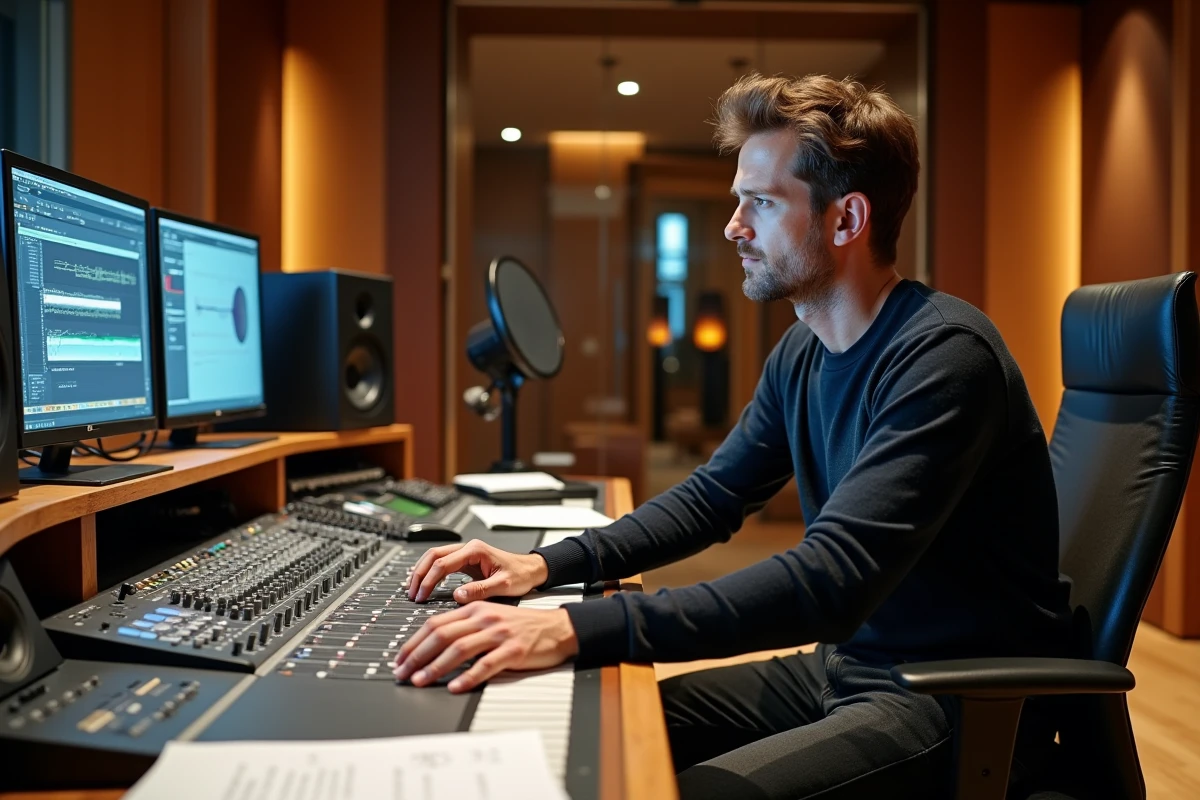
Igor Tikovoi in the studio in London: a lasting presence in the British industry
French producers are often imagined to be confined to Francophone projects. Igor Tikovoi has taken the opposite path by establishing himself firmly in the London ecosystem, where he has worked with labels like Polydor UK, Parlophone, and Fiction Records.
This integration into the British fabric did not happen overnight. Collaborating with English teams requires adopting their studio working methods, mixing standards, and production schedules, which are often tighter than in the French market. Tikovoi has built his credibility project by project, moving from a guest producer role to that of a regular collaborator on singles and albums distributed internationally.
This dual Franco-British identity gives him a concrete advantage: he can assemble session musicians and sound engineers from both sides of the Channel, depending on the needs of a project. You can also find the collaboration between Lio and Igor Tikovoi on Nozzhy, which illustrates this ability to navigate between very different artistic universes.

From full band producer to vocal arrangement specialist
In the early 2000s, Igor Tikovoi’s credits positioned him as a producer of complete sessions, with live recording, band direction in the studio, and final mix supervision. His work resembled that of a pop conductor, present at every stage.
His more recent productions tell a different story. They include mentions of vocal producer, arranger, or additional production, signaling a shift towards vocals and fine arrangements. This shift is not trivial.
What the role of vocal producer changes
Directing a vocal take is not simply pressing “record.” The vocal producer chooses the takes, guides the interpretation, builds the harmonies, and decides on the vocal texture of a piece. It is a meticulous job that requires a very precise ear and a trusting relationship with the artist.
Igor Tikovoi has transitioned from global production to a vocal architect role, which corresponds to a broader trend in the industry: music production is specializing, and artists are seeking collaborators who can intervene on a specific segment rather than on the entire album.
Feedback on this point varies, but several recent technical sheets confirm this evolution towards a more targeted positioning, especially on pop projects where the voice carries the identity of the track.
Igor Tikovoi’s collaborations: the logic behind studio choices
Working with Placebo, Mylène Farmer, and Sophie Ellis-Bextor in the same career might seem inconsistent. These artists have neither the same audience, nor the same sound, nor the same expectations in the studio. This is precisely what makes Tikovoi’s profile clear: he intervenes on the structure and sound color, not on the musical genre.
- With alternative rock bands, his contribution focuses on the density of arrangements and the dynamics of the tracks, maintaining a live energy even in the studio
- On Francophone pop projects, he works more on vocal textures and harmony overlays, with particular attention to the production of choruses
- For artists in the British electro-pop scene, he ensures the link between programming and acoustic elements, a balancing act that requires mastering both worlds
This versatility does not come from nowhere. It is based on a solid musical education and years of practice in studios with very different configurations.
Independent artists and projects outside the mainstream circuit
Recent credit databases show that Igor Tikovoi does not limit his work to big names. He also works on projects by less media-exposed artists from indie scenes or non-Francophone backgrounds.
This work with emerging artists enriches his sound palette and allows him to test approaches that he later reinjects into more visible productions. This is a common practice among experienced producers, but it is rarely documented in biographical articles.

Composition and arrangement at Igor Tikovoi: two distinct professions mobilized together
Composition and arrangement are often confused. Composition is the melodic and harmonic writing of a piece, the raw material. Arrangement is the shaping of this material: which instruments play, when, with what intensity, and in what spatialization.
Igor Tikovoi works on both. He can write a vocal topline and then dress the track with arrangements that serve the artist’s intention without overshadowing it. This dual skill is rare because it requires both melodic sensitivity and technical mastery of production.
In practice, this means that an artist working with Tikovoi does not need to involve multiple contributors between the composition phase and the delivery of the master. The time and coherence gained are real, especially on international projects where back-and-forth between studios can significantly slow down an album’s release.
Igor Tikovoi’s journey reminds us that pop music, even the most tailored for playlists, relies on technical know-how that cannot be reduced to software or a trend. His ability to remain relevant over several decades, between French and British markets, is based on a simple positioning: master the sound before seeking the spotlight.