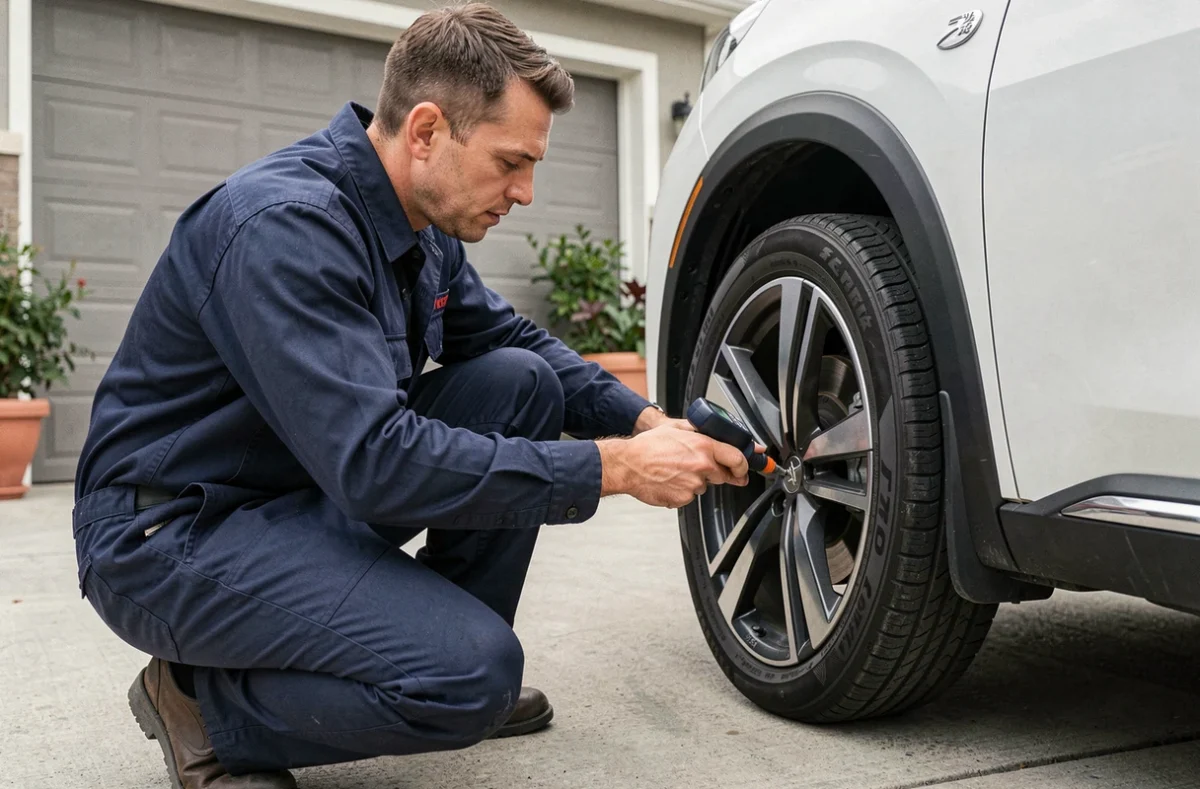
The orange tire pressure warning light remains illuminated on the dashboard, even though you have just inflated all four tires. This situation is common on the Peugeot 2008: the monitoring system does not update automatically after a pressure adjustment. You need to manually indicate that the new values are correct. The process takes less than two minutes, but you need to know where to look in the menus.
Indirect TPMS on Peugeot 2008: what the system really measures
Before touching anything on the touchscreen, understanding how the system works helps avoid mistakes. The Peugeot 2008 uses an indirect TPMS system. Unlike direct sensors screwed into each valve, the indirect system does not measure the actual pressure in the tire.
It relies on data from the ABS sensors on each wheel. An under-inflated tire has a slightly reduced diameter, so it rotates faster than the others. The computer detects this speed difference and triggers the alert.
This approach has a direct consequence: when you correct the pressure, the computer continues to compare the rotation speeds to the old recorded references. As long as you do not initiate the reset, it considers that the situation has not changed. Therefore, the light remains on, even if your tires are perfectly inflated.
This is also why it is possible to reset the tire pressure on Peugeot 2008 without a diagnostic tool: the procedure is entirely through the vehicle’s menu.
Resetting tire pressure via the touchscreen: step-by-step procedure
You may have already noticed that the touchscreen of the 2008 offers many sub-menus? The one we are interested in is located in the “Vehicle” section. Here is the exact path to follow.
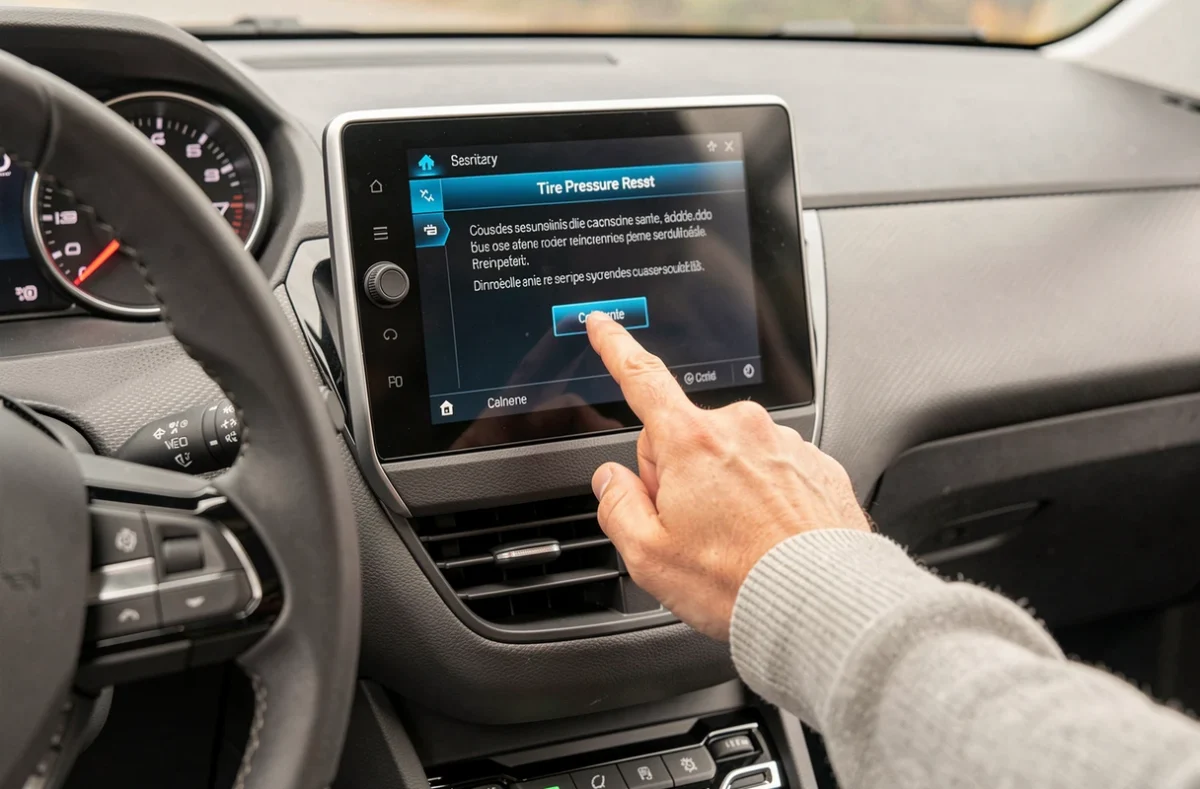
- Turn on the ignition without starting the engine (or start it, both work), then press the “Vehicle” icon on the central touchscreen.
- Select “Vehicle Diagnosis,” then look for the option “Tire Pressure Settings” or “Tire Pressure” depending on the software version of your 2008.
- The screen displays a diagram of the four wheels. Press the validation button or “OK” to initiate the reset. The system then records the current values as the new reference.
A often overlooked point: adjust the pressure before starting the procedure. If you reset with a still under-inflated tire, the computer will record an incorrect reference, and the light will quickly return.
Where to find the correct pressure values
The label affixed to the driver’s door pillar indicates the pressures recommended by Peugeot. You will find two lines: one for normal load and one for heavy load (full vehicle, loaded trunk).
The pressure printed on the tire sidewall is not the recommended pressure. It is the maximum pressure that the tire can handle. Confusing it with the manufacturer’s value is a common mistake that skews inflation and reset.
Tire pressure light stays on after reset: diagnosis
You followed the procedure, drove a few kilometers, and the light refuses to turn off. Several causes explain this situation.
Light stays on after driving
On an indirect system, the computer completes its learning while driving. It needs a few minutes of moderate-speed driving to compare the new rotations. If the light persists after about ten minutes of driving, check each tire again with a reliable gauge.
A slow puncture is the most common cause. A nail embedded in the tread can cause a loss of a few tenths of a bar per day, enough for the system to detect the anomaly after the reset.
Light flashes then stays on
This behavior is different from a simply steady light. A flashing light at startup indicates a fault in the system itself, not a pressure issue. Possible causes include a damaged sensor during tire mounting, a sensor battery nearing the end of its life (on versions equipped with direct sensors), or a wheel not recognized after mounting a second set.
In this case, the reset through the menu is not enough. A visit to a workshop with a diagnostic tool is necessary to identify which sensor is problematic.
Wheel changes and TPMS sensors: traps to know
Mounting new tires or switching to winter wheels regularly creates persistent alerts. Why? Because each direct sensor has a unique identifier that the computer must recognize.
If your second set of wheels is equipped with sensors, they must be paired with the vehicle. A mechanic has a programming tool to perform this operation. Without pairing, the system receives no signal or receives inconsistent data, and the light remains on no matter what you do in the menus.
Another trap: a sensor can be damaged during tire removal by the machine. The TPMS valve protrudes inside the rim, and a sudden movement is enough to break it. If the light appears just after a visit to the tire shop, ask for a sensor check before looking for a pressure issue.
Worn sensor battery
Direct TPMS sensors are powered by a built-in battery with a limited lifespan. Once the battery is depleted, the sensor stops transmitting. Replacement is done by changing the entire sensor, as the battery is not accessible separately on most models.
Resetting the tire pressure on a Peugeot 2008 remains a simple operation as long as the system is functioning correctly. The reflex to keep: always check the actual pressure with a gauge, always adjust according to the manufacturer’s label, and only then initiate the procedure via the touchscreen. If the light persists despite everything, the problem is no longer a matter of inflation, but of electronic diagnosis.